Comparatif
Demo vs Early Access vs Full Release: What to Expect

Cet article n'est pas encore disponible dans votre langue ; il est donc affiché en anglais.
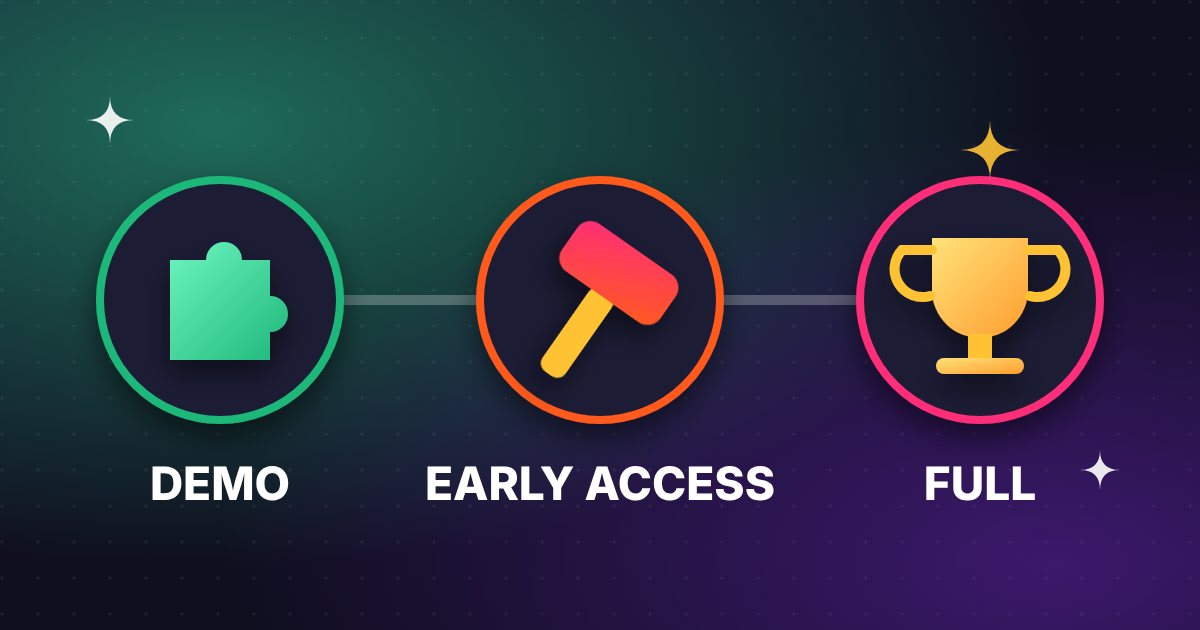
Not every game reaches you in the same state. A demo lets you try a slice for free. Early Access lets you buy and play a game that is still being built. A full release is supposed to be finished. Each option has benefits and risks, and knowing the difference helps you avoid frustration and wasted money. This comparison explains all three in plain language.
At a glance
| Démo | Accès anticipé | Full release | |
|---|---|---|---|
| Cost | Usually free | Full or reduced price | Full price |
| Content | A limited part of the jeu | Unfinished, growing | Complete (in theory) |
| Main risk | May not represent the final jeu | Updates may slow down or stop | Bugs on day one |
| Best for | Checking if you like it | Players who enjoy watching a game grow | Players who want a finished jeu |
Démos
A demo is the safest way to try a game. It is usually free, quick to install and shows you the real controls, art style and pace. A good demo answers the question that matters most: do I enjoy playing this? Demos often appear around big events or just before a release, and some are available for long periods.
Keep in mind that a demo is chosen by the developer. It will usually show the best part of the game, and some demos are older builds that do not match the final version. Still, if you dislike a game during its demo, you have your answer for free. If you love it, you can wishlist the full game with confidence.
Accès anticipé
Early Access means you can buy and play a game while it is still in development. The upside is real: you often pay less than the final price, you can influence the game through feedback, and you get to watch it improve. Many of today's best-loved games were played in Early Access for a long time before reaching version 1.0.
The downside is that you are buying a promise. Development can be slower than planned, features may change, saves can be reset, and some projects are never finished. Before buying, read the developer's roadmap, check how often the game is updated and read the most recent reviews, which are more useful than the overall score. A good sign is a developer who communicates openly about delays and shows steady progress. A warning sign is a roadmap that has not been touched for a year.
Early Access games are best treated as a paid preview. Buy them because you enjoy what exists today, not only because of what is promised.
Full release
A full release is the version the developer considers finished. You should get the promised content, a stable experience and polish. It is the best choice if you want to play without surprises. The price is normally the highest at launch, but it falls over time with sales.
Even so, "finished" does not mean "flawless". Day-one bugs happen, especially on a wide range of PC hardware. If you wait a week or two after launch, patches usually fix the worst problems, and the reviews give you a better idea of the real quality. If a game is not urgent, waiting often means a better experience for less money.
Which should you choose?
- If you are unsure whether you will like a game, play the demo first.
- If you love the concept, accept some rough edges and want to support a small team, Accès anticipé can be great.
- If you want a stable, complete experience, wait for the full release, and ideally for the first patches and reviews.
Keep an eye on what is coming
You do not have to track all of this by hand. On GoNewGames you can follow upcoming releases and see which games already have a demo or are in Early Access, so you can decide how you want to play before you spend anything. Start in our game browser and add the games you are curious about to your wishlist.