Artikel
A Big Discount Is Not the Same as a Good Deal

Dieser Artikel ist noch nicht in deiner Sprache verfügbar und wird deshalb auf Englisch angezeigt.
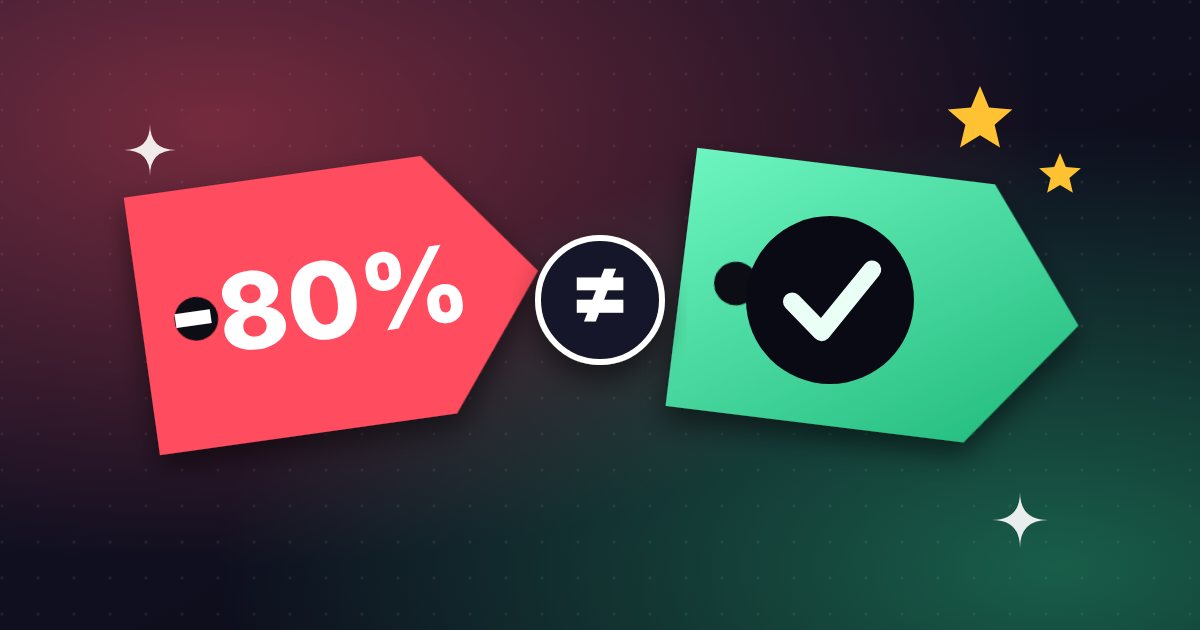
Open any PC store during a sale and the first thing you see is a wall of red numbers: -50%, -75%, -90%. The numbers are designed to make you feel that you are winning. In my experience, the percentage is the least useful piece of information on the page. This is an opinion piece, and I will explain why I think so and what I look at instead.
The percentage describes the old price, not the Spiel
A discount is always measured against some starting price, and the starting price is chosen by the publisher. A game that normally costs sixty dollars and drops to thirty is a different story from a game that was listed at forty dollars for one week so that it could advertise "-75%" at ten dollars. The percentage says nothing about whether ten dollars is a fair price for what you get. It only says how far the publisher has moved from the number it picked itself.
There is also a quieter version of the same trick: games that are almost always on sale. If a title is discounted most of the year, the "sale" price is simply its real price, and the higher number is decoration.
A cheap game you never play is not cheap
The most expensive game is the one you buy and never start. Sales encourage collecting, and collecting feels productive. Many players, myself included, end up with a library of games they bought because the price was "too good to miss". If you add up what you paid for games that stayed uninstalled, the total can be bigger than you expect. A fair test is simple: would you buy this game at this price if it were not on sale today? If the honest answer is no, the discount is not a reason.
Four questions I ask before buying on sale
- What is the lowest price this game has reached before? If today's price is the same as past sales, you can wait for the next one without losing anything. If it is a record low, that is useful information.
- Will I really play it in the next month? If not, a wishlist is free and a purchase is not.
- What do the recent reviews say? Games change. A patch can fix a game or break it, and the most recent reviews reflect the version you will get.
- Is it complete? A discounted base game that needs several paid expansions to feel finished is not as cheap as it looks. Check what is included in the price.
Bundles are not automatically better
Bundles can be excellent, but only if you want most of what is inside. A bundle of five games where you only care about one is rarely a bargain compared with buying that one game at a normal sale price. Do the arithmetic: divide the bundle price by the number of games you will actually play.
Where I think sales are genuinely good
I do not want to sound negative about discounts. They are great for three situations: games you have been watching for a long time, older games with a long track record, and small games you are curious about but not sure of. In the third case, a low price turns a risky purchase into an easy experiment. That is exactly when sales are at their most valuable.
If you want to track prices on games you care about, our game browser lets you filter by price and see current deals in one place, and the discount codes page collects official store codes for members of GNG+.
My conclusion
Treat the discount percentage as advertising and the price as the only number that matters. Decide what a game is worth to you before you look at the sale, not after. You will buy fewer games, play more of them, and the money you save will be real rather than a number on a banner.